
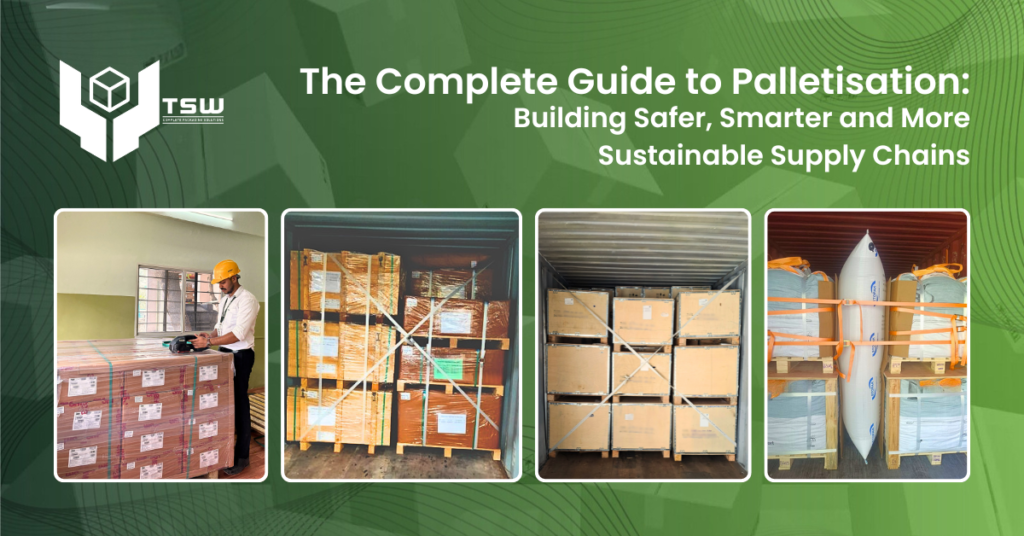
Every day, millions of products travel through warehouses, distribution centers, ports and transportation networks. While packaging often receives significant attention, one critical aspect of logistics is frequently underestimated: palletisation.
A well-designed palletized load does more than simply stack products together. It improves handling efficiency, reduces product damage, optimizes storage space, enhances workplace safety and lowers transportation costs. Conversely, poor palletisation can lead to load collapse, damaged goods, delivery delays, customer complaints and significant financial losses.
According to industry estimates, product damage during transportation costs global businesses billions of dollars annually, with improper palletization and load stabilization being among the leading causes.
For manufacturers, exporters, distributors and logistics professionals, understanding pallet packaging is no longer optional; it’s essential for maintaining supply chain efficiency and protecting profitability.
This guide covers everything you need to know about pallet packaging and palletisation, from fundamentals and best practices to sustainability trends and modern packaging solutions.
What is Palletisation?
Palletisation is the process of arranging, securing, and stabilizing products on a pallet to create a single unit load that can be easily moved, stored, and transported.
The pallet acts as a stable base, while various packaging materials such as stretch film, strapping, corner protectors, and protective wraps ensure the load remains secure throughout its journey.
- The primary objectives of palletisation are:
- Protect products during storage and transit
- Improve warehouse and transportation efficiency
- Enable mechanical handling using forklifts and pallet jacks
- Reduce labor requirements
- Maximize storage and shipping capacity
Why Palletisation Matters
1. Reduces Product Damage
Transportation subjects products to:
- Vibrations
- Sudden braking
- Acceleration
- Road impacts
- Multiple handling points
Without proper pallet stabilization, products can shift, topple, or become crushed.
A well-palletized load minimizes movement and significantly reduces the risk of damage.
2. Improves Warehouse Efficiency
Palletized goods can be:
- Loaded faster
- Stored efficiently
- Retrieved quickly
- Counted accurately
This reduces handling time and improves operational productivity.
3. Enhances Worker Safety
Unstable loads pose serious risks to warehouse personnel.
Proper palletisation reduces:
- Falling products
- Load collapse
- Forklift accidents
- Workplace injuries
4. Optimizes Transportation Costs
Proper pallet design enables:
- Better truck utilization
- Higher container fill rates
- Reduced freight costs
- Fewer damaged shipments
Even a small improvement in pallet efficiency can generate significant annual savings.
The Key Components of an Effective Palletized Load
1. The Pallet Foundation
Everything starts with the pallet itself.
Common Pallet Types
Wooden Pallets
The most widely used option.
Benefits:
- High load-bearing capacity
- Cost-effective
- Suitable for exports (when compliant)
Ideal for:
- Heavy industrial products
- Machinery components
- Engineering goods
Plywood Pallets
A preferred option for many exporters.
Benefits:
- Lightweight
- Strong
- Consistent quality
- Reduced risk of contamination
Plastic Pallets
Benefits:
- Reusable
- Hygienic
- Moisture-resistant
Commonly used in:
- Food
- Pharmaceutical
- Clean-room environments
2. Load Configuration
The way products are stacked directly impacts stability.
Column Stacking
Products are stacked directly above each other.
Advantages:
- Higher compression strength
- Easier counting
Disadvantages:
- Lower resistance to movement
Interlocking Pattern
Products overlap across layers.
Advantages:
- Improved stability
- Better resistance to shifting
Often used in:
- Consumer goods
- Cartons
- Corrugated boxes
Load Stabilization Methods
Stretch Wrapping
One of the most common methods for securing pallet loads.
Benefits
- Excellent load containment
- Dust protection
- Moisture resistance
- Cost-effective
Modern pre-stretch films can reduce plastic consumption while maintaining load stability.
PET Strapping
For heavy-duty applications, strapping provides additional security.
Advantages of PET Strapping
Compared to steel strapping:
- Lighter weight
- Safer handling
- Corrosion resistant
- High tension retention
- Recyclable
PET strapping is widely used for:
- Building materials
- Industrial equipment
- Metal products
- Export shipments
Corner Protectors
Corner protection helps:
- Prevent carton crushing
- Distribute tension evenly
- Improve stacking strength
Especially important for heavy pallet loads.
Dunnage and Void Fill
For export shipments, additional protection may be required.
Examples include:
- Dunnage bags
- Foam inserts
- Corrugated separators
These prevent movement inside containers and trailers.
Common Palletisation Mistakes
Overhanging Products
Products extending beyond pallet edges are highly vulnerable to impact damage.
Best practice:
Keep all items within pallet dimensions.
Poor Weight Distribution
Heavy items should always be placed at the bottom.
Uneven weight distribution increases tipping risk.
Inadequate Wrapping
Insufficient wrapping often leads to load shifting.
At the same time, excessive wrapping increases costs without improving performance.
Finding the right balance is critical.
Ignoring Transportation Conditions
A pallet moving across a factory floor faces different challenges than one traveling thousands of kilometers by road, rail, or sea.
Palletisation should always consider:
- Distance
- Handling frequency
- Weather conditions
- Export requirements
Sustainability in Pallet Packaging
The Growing Importance of Sustainable Palletisation
Companies worldwide are under pressure to reduce packaging waste and improve environmental performance.
Modern palletisation strategies focus on:
Reducing Material Usage
Advanced stretch films provide the same load containment using less material.
Recyclable Packaging
More companies are adopting:
- Recyclable stretch films
- Recyclable PET strapping
- Corrugated protective materials
Reusable Pallets
Reusable pallet systems reduce waste and improve long-term cost efficiency.
Optimized Load Design
Better pallet utilization means:
- More products per shipment
- Fewer truckloads
- Lower carbon emissions
Sustainability and cost savings increasingly go hand in hand.
The Role of Automation in Pallet Packaging
As manufacturing volumes grow, manual pallet packaging often becomes inefficient.
Modern facilities are investing in:
- Automatic stretch wrappers
- Strapping systems
- Conveyor integration
- End-of-line packaging automation
Benefits include:
- Faster throughput
- Consistent wrapping quality
- Reduced labor dependency
- Lower material consumption
- Improved workplace safety
How TSW Delivers Complete Pallet Packaging Solutions
Palletisation is not just about pallets or wrapping film – it requires a complete system approach.
At TSW, we help manufacturers build reliable and efficient pallet packaging processes through:
Strong Foundations
- Plywood pallets and load support systems
Product Protection
- Rust prevention solutions for metal products
- VCI and corrosion-control packaging
Load Stabilization
- PET strapping solutions
- Stretch wrapping systems
- Automated packaging equipment
Heavy-Duty Packaging
- Industrial corrugated packaging solutions
Transit Protection
- Dunnage bags
- Lashing systems
- Container securing solutions
Sustainability Focus
- Material optimization
- Reduced packaging waste
- Environmentally responsible packaging alternatives
By combining these elements, businesses can reduce damage, improve operational efficiency, and lower total packaging costs.
Conclusion
Palletisation is one of the most important and most overlooked elements of modern logistics.
A properly palletized load delivers:
- Better product protection
- ower transportation costs
- Improved warehouse efficiency
- Enhanced worker safety
- Greater sustainability
As supply chains become more demanding, pallet packaging must evolve from a routine warehouse activity into a strategic business function.
The most successful companies are no longer asking, “How do we package products?”
They are asking:
“How do we create stable, efficient, and sustainable unit loads that protect our products and strengthen our supply chain?”
The answer starts with smarter palletisation.