
Introduction
Industrial packaging has evolved significantly over the last decade.
For years, wooden crates were considered the default solution for transporting heavy industrial products. Their strength made them the preferred choice for machinery, automotive components, electrical panels, pumps, fabricated assemblies and export shipments.
Today, however, manufacturers face a different set of challenges.
They are expected to reduce logistics costs, improve sustainability, optimize warehouse space, ensure worker safety and comply with increasingly stringent environmental regulations – all without compromising product protection.
This has led many industries to rethink one important question:
Is heavy wooden packaging still the best packaging solution?
In many applications, the answer is no.
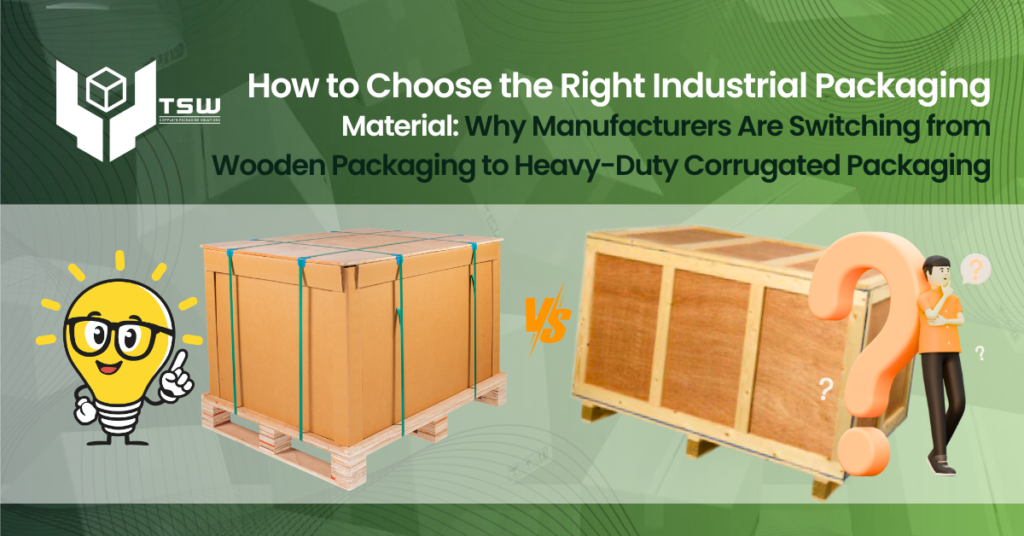
Thanks to advancements in packaging engineering, Heavy-Duty Corrugated (HDC) Packaging has emerged as a high-performance alternative that delivers the strength required for industrial products while offering significant advantages in cost, handling, sustainability and operational efficiency.
At TSW Packaging Solutions, we have successfully replaced wooden packaging with engineered heavy-duty corrugated solutions for products weighing up to 2 tonnes, helping customers improve both performance and profitability.
Why Packaging Material Selection Matters
Packaging is no longer just about protecting a product.
The right packaging directly influences:
- Product safety
- Transportation costs
- Warehouse efficiency
- Export compliance
- Material consumption
- Sustainability goals
- Customer experience
Choosing the wrong packaging material can increase freight costs, slow operations, create handling risks and generate unnecessary waste.
Choosing the right one creates value throughout the supply chain.
Traditional Wooden Packaging: Reliable but No Longer the Only Choice
Wooden crates have served industries well for decades.
They provide:
- High structural strength
- Excellent rigidity
- Good impact resistance
- Suitability for oversized machinery
However, today’s manufacturing environment demands more than just strength.
Businesses are also evaluating:
- Packaging weight
- Storage requirements
- Sustainability
- Ease of handling
- Total packaging cost
- Regulatory compliance
These are areas where engineered heavy-duty corrugated packaging offers compelling advantages.
What is Heavy-Duty Corrugated Packaging?
Heavy-duty corrugated packaging is an engineered packaging solution designed specifically for industrial applications.
Unlike conventional corrugated cartons, HDC packaging uses:
- Multi-wall corrugated board
- High-performance kraft liners
- Reinforced flute combinations
- Engineered structural designs
- Customized protective inserts
- Edge protection systems
- Load-bearing packaging architecture
The result is a lightweight yet highly durable packaging system capable of protecting products weighing hundreds of kilograms – and, in many applications, up to 2 tonnes when properly engineered.
Heavy-Duty Corrugated vs Wooden Packaging
1. Weight: Lighter Packaging, Lower Logistics Costs
One of the biggest disadvantages of wooden packaging is its weight.
Heavy wooden crates increase:
- Transportation costs
- Manual handling effort
- Loading time
- Fuel consumption
Heavy-duty corrugated packaging is significantly lighter while maintaining the structural integrity required for industrial transportation.
Benefits
- Reduced freight charges
- Easier material handling
- Improved warehouse productivity
- Better container utilization
For manufacturers shipping hundreds or thousands of products annually, these savings quickly become substantial.
2. Sustainability: The Future of Industrial Packaging
Sustainability has become one of the biggest drivers of packaging innovation.
Heavy-duty corrugated packaging supports environmental goals by:
- Being manufactured from renewable paper fibers
- Being widely recyclable
- Reducing dependence on timber
- Lowering packaging waste
- Supporting circular economy initiatives
As more organizations adopt ESG objectives, replacing wooden packaging with engineered corrugated solutions contributes to measurable environmental improvements.
For companies committed to reducing their environmental footprint, heavy-duty corrugated packaging is a practical and responsible choice.
3. Lower Total Packaging Cost
The cost of packaging extends far beyond the purchase price.
Businesses should evaluate the Total Cost of Ownership (TCO), which includes:
- Material cost
- Transportation cost
- Storage cost
- Labor cost
- Disposal cost
- Product damage
Although wooden crates may appear durable, their higher weight often increases transportation and handling expenses.
Heavy-duty corrugated packaging reduces these costs while maintaining product protection.
4. Safer Handling for Operators
Worker safety is a critical concern in manufacturing and logistics.
Wooden packaging often contains:
- Nails
- Splinters
- Sharp edges
- Heavy components
- These increase the risk of workplace injuries during packing, handling and unpacking.
Heavy-duty corrugated packaging offers:
- Smooth surfaces
- Safer manual handling
- Lower package weight
- Reduced injury risk
A safer packaging solution contributes to a safer workplace.
5. Better Space Utilization
Warehouse space is expensive.
Traditional wooden boxes occupy significant storage space even before use.
Heavy-duty corrugated packaging can often be supplied in flat-packed form, allowing businesses to:
- Store more packaging in less space
- Reduce warehouse congestion
- Improve inventory management
- Lower storage costs
This is particularly valuable for manufacturers with limited warehouse capacity.
6. Improved Branding & Customer Experience
Industrial packaging is often the first physical interaction customers have with your product.
Unlike wooden crates, heavy-duty corrugated packaging allows for high-quality printing of:
- Company branding
- Product information
- QR codes
- Handling instructions
- Safety labels
A professionally branded package reinforces quality and enhances the customer experience.
7. Engineered Strength for Industrial Applications
A common misconception is that corrugated packaging is only suitable for lightweight products.
Modern heavy-duty corrugated packaging is engineered to withstand demanding industrial environments.
At TSW Packaging Solutions, we have developed heavy-duty corrugated systems that successfully replace wooden crates for products weighing up to 2 tonnes, depending on product geometry, load distribution, handling methods and transportation conditions.
By combining structural engineering with the right packaging materials, it is possible to achieve exceptional performance while significantly reducing packaging weight.
Real Application: Replacing Wooden Packaging with Heavy-Duty Corrugated
One of our customers was using rubberwood pallets with wooden box for electrical control panels.
Challenges
- Heavy overall package weight
- Slow packing process
- Random product placement
- Limited stackability
- No branding
- High material consumption
TSW redesigned the packaging using an engineered Heavy-Duty Corrugated Sleeve, Cap, Tray system with reinforced edge protection.
Results
- Packaging weight reduced by 35%
- Packing time reduced from 12 minutes to 7 minutes
- Logistics cost reduced by 18%
- Packaging material cost reduced by 22%
- Better product organization
- Enhanced stacking strength
- Improved warehouse handling
- Better branding opportunities
- More sustainable packaging solution
The result was not simply a new box it was a more efficient packaging system.
Is Heavy-Duty Corrugated Right for Every Application?
Not necessarily.
Extremely heavy equipment, multiple reuse cycles, or harsh outdoor environments may still require wooden packaging.
The best packaging solution depends on:
- Product weight
- Center of gravity
- Transportation mode
- Export requirements
- Storage conditions
- Handling frequency
At TSW, we don’t replace wood for the sake of replacing wood—we engineer the most effective solution for your specific application.
Why Choose TSW Packaging Solutions?
At TSW Packaging Solutions, packaging is engineered—not selected from a catalogue.
Our team works closely with manufacturers to design packaging systems that balance:
- Product protectionCost optimization
- Sustainability
- Ease of handling
- Supply chain efficiency
Our capabilities include:
- Heavy-duty corrugated packaging
- Transit packaging engineering
- Pallet packaging
- Industrial wrapping
- PET strapping solutions
- Rust prevention packaging
- Packaging automation
- Packaging optimization projects
With a consultative approach and in-house engineering expertise, we help businesses transition from conventional packaging methods to smarter, more sustainable solutions.
Conclusion
The future of industrial packaging is not about choosing the strongest material – it is about choosing the smartest solution.
Heavy-duty corrugated packaging has proven that strength and sustainability can go hand in hand. By reducing weight, lowering logistics costs, improving handling safety, optimizing storage space and supporting environmental goals, it offers manufacturers a compelling alternative to traditional wooden packaging.
For many industrial applications – including engineered solutions for products weighing up to 2 tonnes, heavy-duty corrugated packaging is no longer an alternative. It is a strategic advantage.
If you’re evaluating your current packaging and wondering whether there’s a more efficient approach, the answer may lie not in changing your product, but in redesigning the way you protect it.
Frequently Asked Questions
Yes. For many industrial applications, engineered heavy-duty corrugated packaging can replace wooden crates, offering comparable protection with lower weight, improved sustainability and reduced logistics costs.
Yes. When properly engineered, heavy-duty corrugated packaging can safely protect products weighing up to 2 tonnes, depending on the product, packaging design, and transportation conditions.
Yes. It is widely used for export packaging and, unlike solid wood packaging, generally does not require ISPM-15 treatment, making international shipments simpler.
Yes. Wooden packaging remains suitable for extremely heavy machinery, multiple reuse cycles, and applications requiring exceptional structural strength.
It is manufactured from recyclable paper-based materials, reduces packaging weight, minimizes waste, and helps lower the overall carbon footprint of transportation.